

Buying a camera used to mean choosing between a handful of familiar brands. Buying a drone was even simpler. Today, things are different. There are hundreds of cameras, drones, gimbals, action cameras, microphones, and accessories competing for your money. Some products look impressive in advertisements but become frustrating once you actually start using them. That is why DJI continues to stand out. DJI Official Website
DJI has built a reputation around products that make capturing professional-looking content considerably easier. Whether you’re creating travel videos, filming social media content, recording outdoor adventures, producing commercial footage, or simply want better memories from your next trip, DJI has products designed around exactly those situations. The biggest reason people keep coming back to DJI isn’t just image quality. It’s how easy the technology makes it to get the shot you imagined.
Why DJI Is Worth Considering Before You Buy
Let’s be honest about what happens when people buy cameras. They compare megapixels, frame rates, sensor sizes, stabilization, battery life, and countless other specifications. They watch endless reviews and comparisons before finally making a decision. Then, sometimes, the camera ends up sitting in a drawer because it’s too complicated or inconvenient to carry.
DJI Official Website
That’s the problem with buying technology based entirely on specifications. The best product isn’t necessarily the one with the longest specification sheet. It’s the one you’re actually going to use. DJI has become extremely good at designing products around portability, stabilization, intelligent features, and straightforward operation. That combination makes its products particularly attractive to people who want high-quality footage without turning every recording session into a technical project.
DJI Is More Than Just Drones
When someone says DJI, most people immediately think about drones. That’s understandable because DJI has become one of the most recognizable names in consumer drones. But the company has expanded far beyond aerial photography.
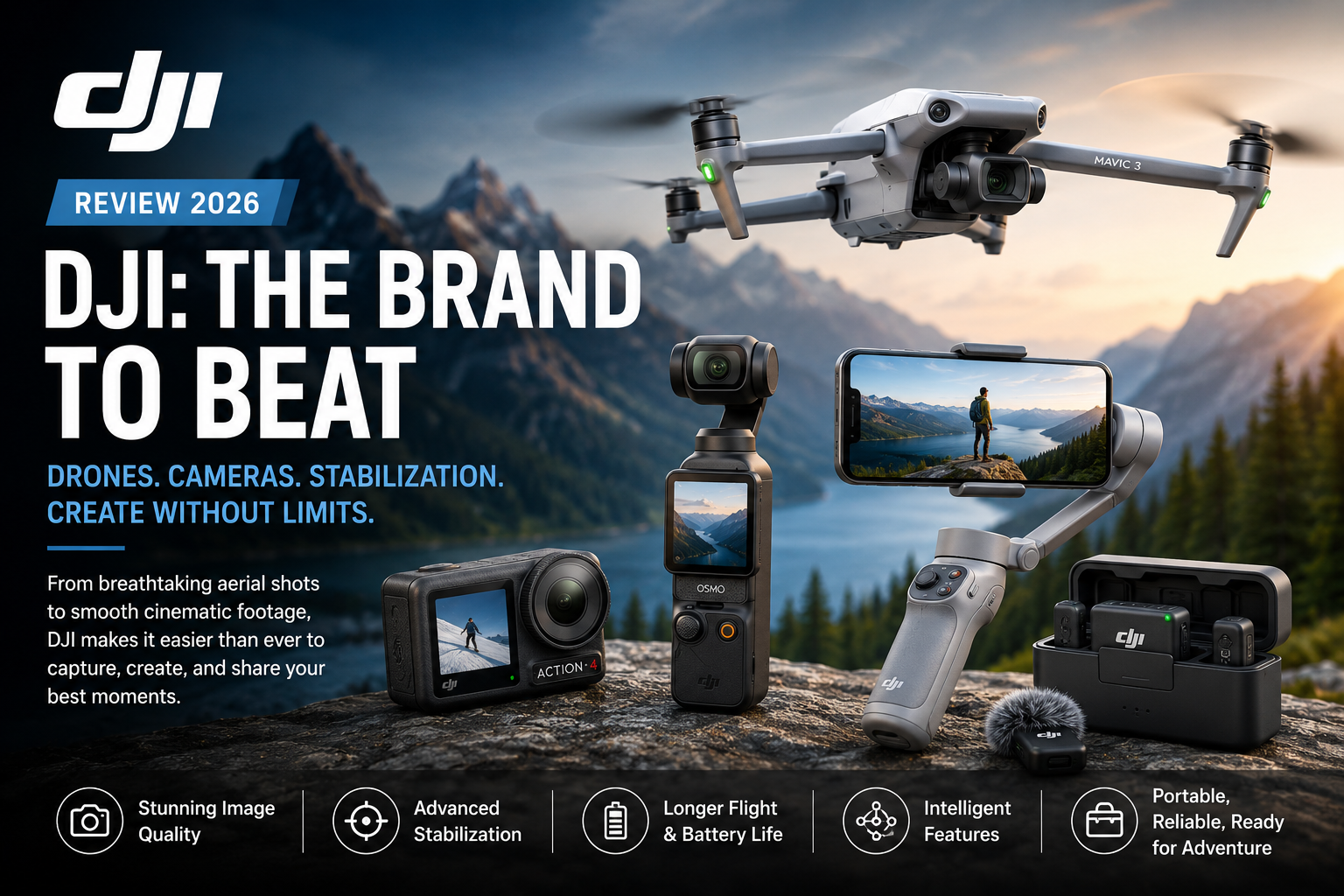
DJI now has products across categories such as camera drones, action cameras, handheld cameras, gimbals, wireless microphones, camera accessories, and professional imaging equipment. This means you can build an entire content-creation setup around DJI.
You might start with a drone, then add an action camera, followed by a gimbal and wireless microphone. Eventually, you could have almost everything needed to create professional-looking travel, YouTube, or social media content. That’s one of the strongest reasons to consider staying within the DJI ecosystem.
DJI Drones Are the Main Attraction
If you’re specifically shopping for a drone, DJI deserves to be near the top of your list. The biggest advantage isn’t simply that DJI drones can fly. Lots of drones can fly. The difference is what happens after you take off.
DJI Official Website
You want stable footage, responsive controls, reliable flight performance, intelligent features, and a camera that captures footage worth keeping. Ideally, you also want the drone to help you get the shot without requiring years of experience.
That’s where DJI’s experience becomes valuable.
Think about what you’re trying to capture. A mountain landscape, a beach, a road trip, a wedding venue, a property, a family vacation, or a cinematic establishing shot can all look completely different from the air. A drone gives you a perspective that would otherwise be difficult or expensive to achieve.
DJI Makes Cinematic Footage More Accessible
Professional-looking aerial footage once required expensive equipment, extensive training, and sometimes a professional crew. Modern consumer drones have changed that.
DJI’s intelligent flight features and stabilization technology help reduce some of the technical barriers between you and the footage you want. That doesn’t mean you can simply press a button and instantly become a professional filmmaker. Composition, lighting, camera movement, and editing still matter.
However, the technology can handle much of the difficult mechanical work. That means you can concentrate more on what you’re actually trying to create.
DJI Mini Drones Make Portability Extremely Attractive
One of the biggest complaints people have about drones is simple: they’re annoying to carry.
You don’t want to take a huge case on vacation. You don’t want to spend 20 minutes assembling equipment. You don’t want your drone to become another piece of luggage you regret bringing.
That’s why compact drone designs are so appealing. DJI’s Mini series is particularly attractive to travelers and casual creators who want aerial footage without carrying a large aircraft.
A compact drone is easier to pack, easier to transport, easier to bring on trips, and more likely to actually be used. And that last point is extremely important. A drone that stays at home isn’t helping you create anything.
DJI Mavic Is for People Who Want More
If you’re more serious about aerial photography and videography, the Mavic family is where things become more interesting. Mavic drones are designed for people who want more advanced imaging capabilities, intelligent flight features, and a more sophisticated overall experience.
This is where you should start looking if you’re creating real-estate footage, travel productions, commercial videos, cinematic projects, or high-quality YouTube content.
If you’re spending time and money building a serious content operation, buying a more capable drone can make more sense than starting with an entry-level model and upgrading shortly afterward.
DJI Air Is the Middle Ground
The DJI Air family has historically occupied an attractive middle position. You get more capabilities than an ultra-compact beginner-focused drone without necessarily moving into the largest professional equipment category.
That’s useful for creators who want serious performance without turning their entire setup into a production truck. For many users, this middle ground can be the sweet spot because it combines advanced capabilities with relatively manageable size and weight.
DJI Action Cameras Are Perfect for People Who Don’t Want a Traditional Camera
Drones aren’t the only reason to buy DJI. Action cameras have become extremely popular because people want to record things that would be difficult to capture with a conventional camera.
Cycling, hiking, swimming, travel, motorcycling, skiing, running, water sports, and road trips are all situations where a compact action camera can be incredibly useful.
DJI’s Osmo Action line gives you a compact way to capture those moments. The biggest advantage is convenience. You don’t have to carry a large camera or worry about constantly changing lenses. You can simply mount the camera, turn it on, and start recording.
Why Action Cameras Are Better for Travel
Imagine you’re going on a two-week trip. You could bring a DSLR or mirrorless camera, several lenses, a tripod, batteries, and a camera bag. Or you could bring a compact action camera that lives in your backpack.
That doesn’t mean an action camera replaces a professional camera. It doesn’t. But for everyday travel footage, convenience can be more important than ultimate image quality.
You’ll capture more moments because the camera is always ready. That’s a major advantage for travelers who don’t want photography equipment to become a burden.
DJI Osmo Pocket Is a Different Kind of Camera
The DJI Osmo Pocket series is particularly interesting for creators who want something between a smartphone and a traditional camera.
Its compact handheld design makes it easy to carry. You can take it on travel trips, city walks, family vacations, events, food tours, street shoots, and everyday adventures.
The integrated gimbal helps produce smoother footage than you might get from simply holding a conventional camera. Smooth footage immediately looks more polished, which is why stabilization can make such a noticeable difference.
Why Gimbal Stabilization Matters
You might think stabilization is a small feature. It isn’t.
Watch two videos side by side. One is shaky while the other is smooth. Even if both were filmed in the same location, the smoother footage usually feels more professional.
That’s because your eyes naturally notice unwanted movement. DJI has invested heavily in stabilization technology across its camera ecosystem, which makes its gimbals and handheld cameras particularly appealing to creators who want professional-looking footage without complicated rigs.
DJI Gimbals Can Transform Your Smartphone
Here’s one of the easiest DJI purchases to justify. You already have a smartphone. Your phone probably takes excellent video. But there’s a problem: your hands move.
You walk, turn, pan, and accidentally shake the camera. A smartphone gimbal can make those movements much smoother.
Suddenly your phone footage looks more intentional. That’s particularly useful for TikTok, Instagram Reels, YouTube Shorts, travel videos, product videos, restaurant content, real-estate walkthroughs, and small-business marketing.
You don’t necessarily have to buy a dedicated camera. You can upgrade the camera you already own.
DJI Mic Is for Creators Who Care About Audio
Here’s something many beginners learn the hard way: bad audio can ruin good video.
You can have beautiful 4K footage, cinematic camera movement, and excellent lighting, but if the person speaking sounds distant or unclear, the video immediately feels less professional.
That’s why DJI’s wireless microphone products are worth considering if you create talking-head content, interviews, travel videos, tutorials, or social media content.
A better microphone can produce a surprisingly large improvement. Viewers may not consciously notice excellent audio, but they absolutely notice poor audio.
DJI Is Especially Good for Content Creators
If you’re building a YouTube channel or social media account, DJI’s ecosystem becomes particularly attractive.
Imagine a creator setup consisting of a DJI drone for aerial footage, an Osmo Action camera for adventure footage, an Osmo Pocket for walking shots, a DJI gimbal for smartphone footage, and a DJI wireless microphone for talking.
That’s already a complete content-creation system.
You don’t need to buy everything at once. Start with the product that solves your biggest problem and expand later.
DJI for Travel Creators
Travel is probably one of the best reasons to invest in DJI equipment.
Think about what makes travel footage interesting. It’s not just landmarks. It’s movement, people, roads, beaches, mountains, hotels, food, local streets, sunsets, aerial perspectives, walking sequences, and conversations.
DJI has products that can cover almost every one of these situations.
A drone gives you the aerial shot. An action camera captures adventure. A Pocket-style camera handles walking footage. A microphone improves your voice. A gimbal smooths smartphone footage.
That flexibility can turn ordinary vacation clips into something you actually want to watch years later.
DJI for YouTube
You don’t need an expensive cinema camera to start a YouTube channel. In fact, buying too much equipment at the beginning can be counterproductive.
You spend months learning the equipment instead of creating videos.
DJI products can offer a more approachable path. Start with a compact camera or smartphone gimbal, add a microphone, learn editing, improve your storytelling, and then consider adding a drone.
Your content quality will improve much more from consistent publishing than from constantly buying more expensive equipment.
DJI for Real Estate
Real estate is another area where drones and stabilized cameras can make a major difference.
Aerial footage can show the property, surrounding neighborhood, landscape, driveway, nearby amenities, and overall location.
Instead of showing only four walls, you’re showing the entire context. That can make property marketing considerably more visually compelling.
Of course, drone operators need to follow applicable aviation laws and restrictions in their location. But where permitted, aerial footage can be a powerful marketing tool.
DJI for Small Businesses
You don’t have to be a filmmaker to benefit from better video.
Small businesses need content constantly. Restaurants need social media videos. Hotels need property footage. Gyms need promotional videos. Real estate agents need listing footage. Tour operators need travel content. Retailers need product videos.
A DJI setup can help a small business create better content without hiring a production company every time.
That’s a serious advantage, especially for businesses that need to publish frequently.
DJI Makes It Easier to Look Professional
There’s a psychological difference between footage that looks homemade and footage that looks intentional.
Good stabilization helps. Good audio helps. Good lighting helps. Aerial footage helps. Consistent framing helps.
DJI products are designed around many of these problems.
You’re still responsible for the creative decisions, but the equipment can help you execute them. That means you can concentrate on storytelling instead of constantly fighting your camera.
Which DJI Product Should You Buy?
Don’t buy the most expensive DJI product just because it’s the best. Buy according to what you’re actually trying to create.
If you want portability and are new to drones, a DJI Mini-style drone can be an appealing starting point. If you create content regularly and want a balance between portability and capability, the DJI Air family can be worth considering. If you’re serious about aerial photography and professional content, the Mavic family may make more sense.
If you want an adventure camera, the Osmo Action family is worth looking at. If you vlog and want smooth handheld footage, Osmo Pocket can be an attractive choice. If you primarily shoot with your smartphone, a DJI gimbal can be a relatively simple way to improve your videos. If you talk on camera or record interviews, a DJI wireless microphone can address one of the most common weaknesses in beginner content.
Don’t Buy Equipment You’ll Never Use
This is probably the most important advice in the entire article.
Technology is exciting. It’s easy to convince yourself that you need everything.
You don’t.
If you mainly make Instagram videos with your phone, you may not need a professional drone. If you travel every month, a compact camera may make more sense than a large setup. If you’re a serious filmmaker, don’t buy an entry-level product simply because it’s cheaper.
Think about your actual use case.
Then buy accordingly.
DJI’s Biggest Advantage Is the Ecosystem
This is what makes DJI particularly easy to buy from.
You aren’t necessarily purchasing one isolated device.
You’re entering an ecosystem.
A drone can complement your camera. A microphone can improve your camera. A gimbal can improve your phone. An action camera can capture footage your other camera can’t.
Each product solves a different problem.
That’s much more useful than buying random accessories from five different brands.
Is DJI Worth the Money?
For many users, yes.
But value doesn’t mean buying the most expensive model. Value means getting equipment that makes a noticeable improvement to what you’re creating.
If a DJI gimbal helps you create better videos every week, that’s value. If a DJI microphone makes your YouTube videos sound significantly better, that’s value. If a DJI drone gives you footage you couldn’t capture otherwise, that’s value. If an action camera lets you record adventures without worrying about carrying a large camera, that’s value.
The right DJI product can pay for itself creatively.
DJI Pros
DJI offers a strong reputation in drones and imaging, excellent stabilization technology, a wide range of products, compact options for travelers, advanced drones for serious creators, action cameras, handheld cameras, smartphone gimbals, wireless microphones, and a strong creator ecosystem.
The brand is particularly attractive for travel content, YouTube, social media, professional projects, and people who want to improve their footage without building an overly complicated camera setup.
Things to Consider Before Buying
Higher-end DJI products can become expensive, and the best model depends heavily on your specific use case. Drone owners also need to follow local aviation laws and restrictions.
Accessories, additional batteries, storage cards, cases, and other equipment can increase the overall cost. Professional features may also be unnecessary for casual users.
Technology changes quickly, so it’s worth comparing the current DJI lineup and checking the latest specifications before making a purchase.
Final Verdict: Should You Buy DJI in 2026?
If you’re serious about creating better photos or videos, DJI is one of the first brands I’d look at.
The reason isn’t simply that DJI makes powerful equipment.
It’s because the company understands something important: technology should help you create, not get in your way.
A drone should make aerial photography easier. A gimbal should make movement smoother. An action camera should make adventure recording simpler. A handheld camera should make everyday filmmaking more convenient. A wireless microphone should make your voice clearer.
When those things work together, you spend less time fighting your equipment and more time creating.
And that’s ultimately what makes DJI so appealing.
You don’t need to become a professional filmmaker before buying professional-looking equipment. You don’t need to spend hours learning complicated camera systems. You don’t need to carry a huge bag everywhere.
You simply need to choose the product that matches the way you actually create.
If you’re planning a vacation, upgrading your YouTube setup, starting a social media channel, creating business content, filming outdoor adventures, or simply want your memories to look dramatically better, DJI is absolutely worth considering.
Start with one product. Use it. Learn it. Create with it. Then, when you discover what your setup is missing, expand the ecosystem.
Because the best camera isn’t the one with the longest list of specifications.
It’s the one that makes you want to pick it up and create something.
And that’s exactly where DJI continues to be hard to ignore.