

Running a small business sounds simple until you actually have to manage the people behind it.
You need to know who’s working.
Who’s late.
Who’s taking time off.
How many hours everyone worked.
Whether payroll information is accurate.
Whether employees saw the schedule.
Whether someone remembered to clock in.
And then there are the messages, announcements, shift changes, availability requests, onboarding, and countless small tasks that somehow consume hours every week.
This is where Homebase becomes interesting.
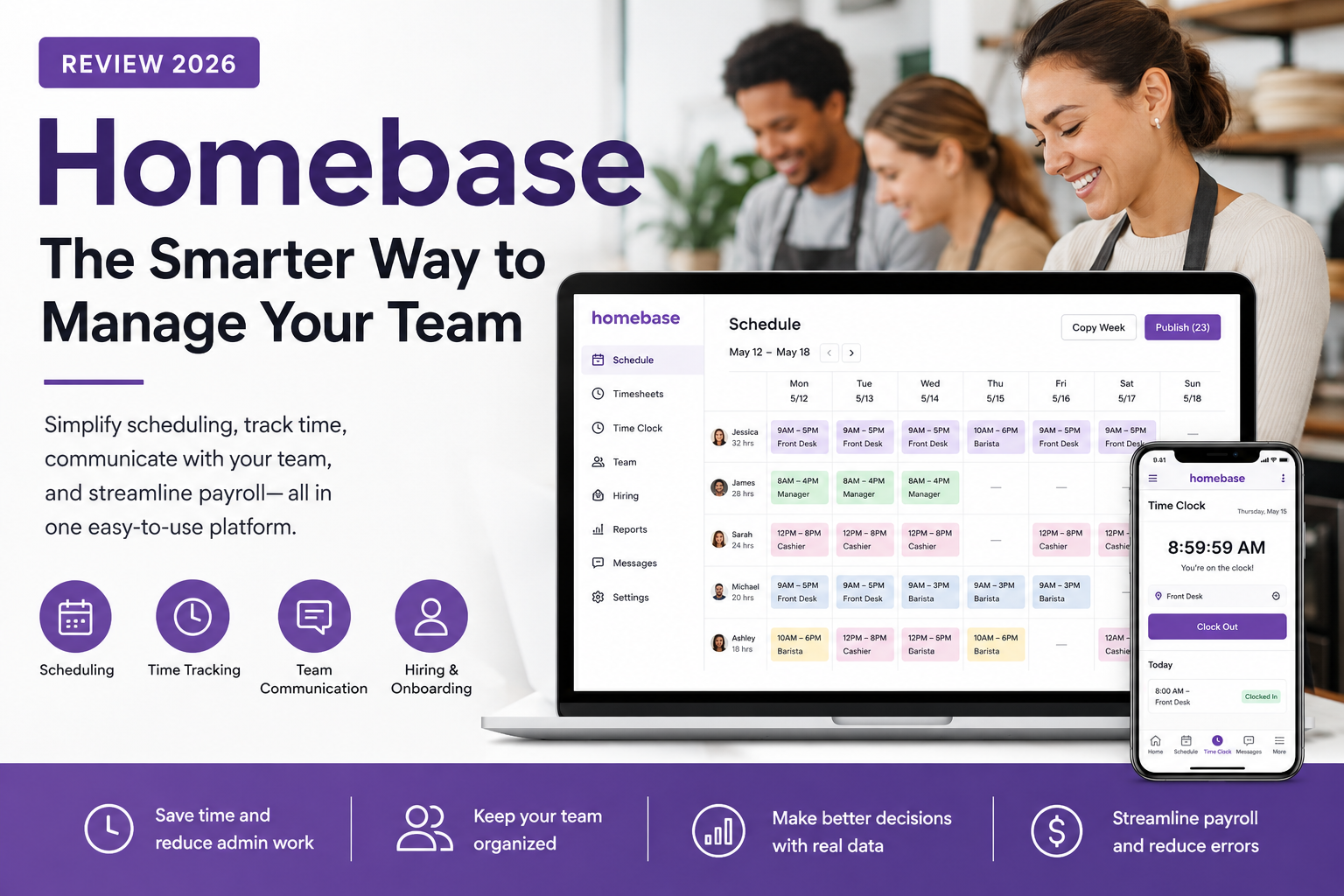
Homebase is designed specifically around hourly teams and small businesses, bringing scheduling, time tracking, payroll-related tools, team communication, hiring, onboarding, and employee management into one platform.
Instead of trying to manage your workforce through spreadsheets, paper schedules, text messages, and separate apps, Homebase gives you a centralized place to handle the everyday operational work that comes with running a team.
And if you’re still managing employee schedules manually, this is the kind of software that can make you wonder why you waited so long to switch.
Homebase Official Website
Why Homebase Is Worth Considering
Let’s start with the biggest problem.
Managing employees manually gets expensive.
Not necessarily because the software is expensive.
Because your time is expensive.
Imagine spending hours every week:
Creating schedules.
Checking availability.
Messaging employees.
Fixing missed punches.
Calculating hours.
Approving time off.
Answering questions about shifts.
Following up with employees.
Then repeating the entire process the following week.
That’s a lot of administrative work for something that should be relatively straightforward.
Homebase is built to reduce that workload. Homebase Official Website
The platform is particularly focused on hourly businesses such as restaurants, retail stores, salons, healthcare businesses, beauty businesses, and other small businesses with shift-based employees.
If your team works different shifts, that’s where Homebase becomes especially compelling.
Homebase Is Built Around Your Employees
One of the most attractive things about Homebase is that it isn’t just a manager dashboard.
Employees interact with the system too.
That matters.
Because the best workforce software isn’t the one that gives managers another complicated screen.
It’s the one employees actually use.
Employees can use Homebase for things like:
- Viewing schedules
- Clocking in and out
- Requesting time off
- Communicating with coworkers
- Checking shift information
- Managing availability
- Receiving important updates
That means fewer questions for the manager.
Instead of someone constantly asking:
“When am I working?”
They can simply check the schedule.
Instead of:
“Can I take Friday off?”
They can submit the request.
Instead of:
“Did you get my message?”
The communication can happen within the platform.
Small improvements like these add up quickly.
Scheduling Is Probably Homebase’s Biggest Selling Point
If you’ve ever created an employee schedule manually, you already know how frustrating it can be.
One person isn’t available Monday.
Someone else needs Tuesday off.
Another employee can only work evenings.
Someone calls in sick.
You need to find a replacement.
Then you update the schedule.
Then you have to tell everyone.
Then someone says they didn’t see the new schedule.
It’s a cycle.
Homebase is designed to make scheduling easier.
You can create employee schedules, communicate shifts, and make changes without relying entirely on spreadsheets or group chats.
That can be a huge advantage for businesses with constantly changing schedules.
Why Automated Scheduling Can Save So Much Time
Imagine having a schedule that takes minutes to update instead of hours to rebuild.
That’s where the value starts.
You can account for:
Employee availability.
Shift requirements.
Staffing needs.
Time-off requests.
Changes in coverage.
Then communicate the final schedule to your team.
The goal isn’t simply to create a prettier schedule.
It’s to reduce the amount of repetitive work involved in maintaining it.
And for a small business owner, that’s valuable.
Your time should be spent growing the business—not rebuilding spreadsheets.
Employees Can See Their Schedule From Their Phones
This is another reason Homebase can be convenient.
Your employees don’t need to wait for a printed schedule on a wall.
They can access their schedule digitally.
That means they can check:
When am I working?
What time does my shift start?
Where am I scheduled?
Has my manager changed anything?
Having the information available through a mobile experience can reduce unnecessary communication.
And when you’re managing a team, fewer repetitive questions can make a noticeable difference.
Time Tracking Makes Homebase Even More Useful
Scheduling is only half the problem.
You also need to know how many hours employees actually worked.
That’s where time tracking comes in.
Homebase provides clock-in and clock-out functionality designed for hourly teams.
Employees can clock in.
Work their shift.
Clock out.
Managers can then review the recorded hours.
This creates a much cleaner connection between:
Schedule → Actual hours → Payroll
Instead of trying to reconstruct everything manually.
No More Guessing About Hours
Imagine you have ten employees.
Each person works different shifts.
Someone comes in early.
Someone stays late.
Someone forgets to clock out.
Someone takes a longer break.
If you’re tracking everything manually, mistakes are almost inevitable.
Digital time tracking makes it easier to identify discrepancies before they become payroll problems.
And that’s important because payroll mistakes don’t just create administrative work.
They create employee frustration.
If someone believes their paycheck is wrong, suddenly you’re spending even more time investigating.
Better time records can reduce those situations.
Homebase Can Help With Payroll Preparation
Payroll is one of the least exciting parts of running a business.
It’s also one of the areas where mistakes can become expensive.
Homebase connects time tracking and payroll-related workflows, helping businesses move employee hours into the next stage of payroll processing.
The exact capabilities depend on the plan and payroll setup you choose, so businesses should check the current features before purchasing.
But the basic idea is powerful:
Stop entering the same information repeatedly.
The more your systems can communicate with one another, the less manual work you have to do.
Employee Communication Becomes Easier
Small businesses don’t necessarily need a complicated corporate communication platform.
They need a way to tell employees:
“Your shift changed.”
“Don’t forget tomorrow’s meeting.”
“We need someone to cover Saturday.”
“New policy starts next week.”
“Please check the updated schedule.”
Homebase includes team communication functionality designed around these types of workplace interactions.
That’s useful because you don’t necessarily want important work information buried inside someone’s personal messaging app.
Keeping workplace communication connected to the workplace makes more sense.
Shift Swapping Can Reduce Manager Headaches
One of the most annoying situations for managers is the employee who suddenly can’t work.
The employee needs someone to cover.
The manager gets contacted.
Now the manager has to find someone.
Homebase provides functionality around shift trades and coverage, allowing employees to participate in solving scheduling problems rather than making the manager responsible for every single change.
That can make a significant difference.
Instead of:
Employee → Manager → Employee 2 → Manager → Schedule update
you can create a more streamlined process.
And when you have dozens of employees, reducing that back-and-forth matters.
Time-Off Requests Are Easier to Organize
Another common headache is managing time off.
Employees need vacations.
They have appointments.
They need personal days.
You need to know whether the business can still operate.
Homebase allows employees to submit time-off requests while managers can review them against scheduling requirements.
That’s much cleaner than getting requests through:
Text messages.
WhatsApp.
Email.
Paper.
Verbal conversations.
Sticky notes.
If you’ve ever forgotten a verbal time-off request, you already know why having a centralized system is useful.
Employee Availability Matters Too
Scheduling becomes easier when managers know when employees can actually work.
Availability can change.
A student might have a new class schedule.
A parent might have childcare restrictions.
Someone might take another job.
Someone’s preferred hours might change.
Keeping this information organized can help you build better schedules.
Instead of discovering availability problems after creating the schedule, you can account for them earlier.
Homebase Can Help With Hiring Too
Homebase isn’t limited to scheduling and time tracking.
The platform also includes hiring-related tools designed to help small businesses find and onboard employees.
That’s particularly useful because hiring and scheduling are connected.
You don’t just need to hire someone.
You need to get them into the system.
Collect the necessary information.
Help them understand their role.
Get them scheduled.
And eventually track their hours.
Having multiple workforce functions connected can make that process easier.
Onboarding Is Another Time Saver
Hiring someone is only the beginning.
You then have to get them ready.
Forms.
Policies.
Training.
Schedule.
Communication.
Expectations.
The faster you can move someone from “new hire” to “productive employee,” the better.
Homebase includes onboarding functionality intended to help businesses manage this process.
That can reduce the amount of repetitive administrative work involved in bringing new employees onto the team.
Homebase Makes More Sense as Your Team Gets Bigger
If you’re a solo business owner with one employee, you might not need sophisticated workforce software.
But once you have a team, complexity grows quickly.
Five employees.
Ten employees.
Twenty employees.
Thirty employees.
Suddenly the spreadsheet that worked perfectly fine six months ago becomes a nightmare.
That’s when a platform like Homebase becomes much easier to justify.
The bigger the team, the more valuable organization becomes.
And the more shifts you have, the more valuable automated scheduling and time tracking become.
Homebase for Restaurants
Restaurants are one of the clearest use cases.
You have:
Servers.
Hosts.
Kitchen staff.
Bartenders.
Managers.
Different shifts.
Different availability.
Busy weekends.
Slow weekdays.
Call-outs.
Last-minute schedule changes.
Restaurants need flexible scheduling more than many traditional office businesses.
Homebase is designed with hourly businesses such as restaurants in mind, making its scheduling and time-tracking features particularly relevant.
A restaurant manager shouldn’t have to spend half their day rebuilding next week’s schedule.
The software should do more of the administrative work.
Homebase for Retail
Retail businesses have similar problems.
You may have:
Opening shifts.
Closing shifts.
Weekend coverage.
Sales associates.
Managers.
Part-time employees.
Seasonal workers.
Holiday staffing.
Homebase can help bring those schedules and employee hours into one system.
That can make staffing much easier to organize.
And during busy seasons, that organization becomes even more important.
Homebase for Salons and Beauty Businesses
Salons have another scheduling challenge.
Employees may work different hours.
Appointments change.
Staff availability changes.
Some employees may work part time.
You need to know who’s working and when.
A digital workforce management system can make these moving pieces easier to organize.
The goal isn’t to make your business more complicated.
It’s to eliminate unnecessary complexity.
Homebase for Small Healthcare Teams
Healthcare and care businesses can also have complex hourly staffing requirements.
Different shifts.
Different employees.
Different availability.
Coverage requirements.
Time tracking.
That makes workforce organization particularly important.
Businesses should always evaluate whether the platform’s current features and compliance capabilities match their specific industry requirements, but the scheduling and time-management concept can be highly relevant to hourly teams.
Homebase Isn’t Just About Saving Money
This is important.
Don’t evaluate Homebase purely by asking:
“How much does the software cost?”
Ask:
“How much does my current process cost me?”
If you spend five hours a week managing schedules and correcting time records, that’s 20+ hours every month.
Now imagine reducing that workload significantly.
What is that time worth?
Maybe you could:
Find new customers.
Improve operations.
Train employees.
Work on marketing.
Spend time with family.
Take a day off.
That’s the real value.
The Employee Experience Matters Too
Managers aren’t the only ones who benefit from better workforce software.
Employees want clarity.
They want to know when they’re working.
They want to request time off without chasing a manager.
They want accurate hours.
They want easy communication.
They want fewer surprises.
A better employee experience can also contribute to a better workplace.
When scheduling feels chaotic, employees feel it.
When scheduling is organized, everyone benefits.
Why Homebase Can Be Better Than a Spreadsheet
Spreadsheets aren’t bad.
They’re just limited.
A spreadsheet can show:
Monday: John
Tuesday: Sarah
Wednesday: Mike
But workforce management involves much more than displaying names.
You need:
Availability.
Time off.
Actual hours.
Clock-ins.
Clock-outs.
Communication.
Shift changes.
Employee information.
Payroll-related information.
Hiring.
Onboarding.
As the business grows, the spreadsheet becomes less useful.
Homebase is designed specifically around those workforce processes.
That’s the difference.
Homebase Can Reduce Administrative Mistakes
No system eliminates every mistake.
But centralizing information can reduce opportunities for human error.
If employee schedules are stored in one place, there’s less confusion.
If hours are recorded digitally, there’s less manual entry.
If time-off requests are centralized, there’s less chance of forgetting one.
If communication happens within the platform, there’s less information scattered across different apps.
The fewer places you need to look, the easier the business becomes to manage.
Is Homebase Easy to Justify Financially?
For many small businesses, the answer depends on team size and which features they need.
Homebase offers different plans and functionality, so you should compare the current pricing against the features your business actually needs.
But here’s the important part:
Don’t compare the monthly subscription against zero.
Compare it against your current process.
If you’re paying an employee or manager to spend hours doing administrative work, software that reduces that work can potentially pay for itself through time savings.
That’s the calculation that matters.
What I Would Use Homebase For First
If you’re currently managing everything manually, don’t try to change your entire operation overnight.
Start with three things:
1. Scheduling
Move your employee schedules into Homebase.
2. Time Tracking
Let employees clock in and out digitally.
3. Time-Off Requests
Stop managing vacation requests through scattered messages.
Once those processes are working, add more features as needed.
This makes adoption easier for your team.
Homebase Pros
✔ Employee scheduling
✔ Time tracking
✔ Clock-in and clock-out
✔ Time-off management
✔ Team communication
✔ Shift management
✔ Hiring tools
✔ Employee onboarding
✔ Payroll-related functionality
✔ Mobile accessibility
✔ Designed for hourly teams
✔ Useful for restaurants and retail
✔ Can replace multiple manual processes
Things to Consider Before Buying
✘ The best plan depends on your business needs
✘ Some advanced features may require higher-tier plans
✘ Employees need to actually use the system consistently
✘ Businesses should review current payroll and integration compatibility
✘ Larger or highly specialized organizations may need more advanced enterprise tools
Is Homebase Worth It in 2026?
If you’re running a small business with hourly employees and you’re still managing schedules, time tracking, and employee communication manually, Homebase is absolutely worth considering.
The biggest reason isn’t that it has a long list of features.
It’s that those features solve problems that small-business owners deal with every single week.
Scheduling.
Clock-ins.
Time tracking.
Time off.
Communication.
Hiring.
Onboarding.
Payroll workflows.
These aren’t optional tasks.
You have to do them.
The question is whether you’re going to keep doing them manually.
And that’s where Homebase becomes compelling.
Instead of opening a spreadsheet every Sunday night to build next week’s schedule, you can manage it digitally.
Instead of collecting hours manually, you can track them.
Instead of chasing employees for availability, you can organize it.
Instead of receiving time-off requests through random messages, you can centralize them.
Instead of spending your day answering basic scheduling questions, employees can access their own information.
That’s the kind of software that can quietly make a business easier to run.
Final Verdict: Should Your Business Use Homebase?
If you manage hourly employees, it’s worth taking seriously.
You don’t need to be running a massive company.
In fact, Homebase can make even more sense for small businesses because small teams usually don’t have dedicated HR departments handling all of these administrative tasks.
The owner or manager does it.
And every hour spent fixing schedules is an hour that isn’t spent growing the business.
That’s the real reason to consider Homebase.
You’re not buying another piece of software.
You’re buying back time.
You’re creating a more organized workplace.
You’re making schedules easier to manage.
You’re giving employees better access to their information.
And you’re reducing the number of repetitive administrative tasks sitting on your desk.
If you’re still using spreadsheets, paper schedules, group chats, and manual time tracking, now is a good time to ask yourself:
How much longer do I really want to manage my workforce that way?
Because your business may already have outgrown the system you’re using.
Homebase gives small businesses a simpler way to manage the people who keep the business running.
And if saving time, reducing scheduling headaches, and getting your team organized sounds valuable, Homebase is one of the workforce-management platforms worth trying.