

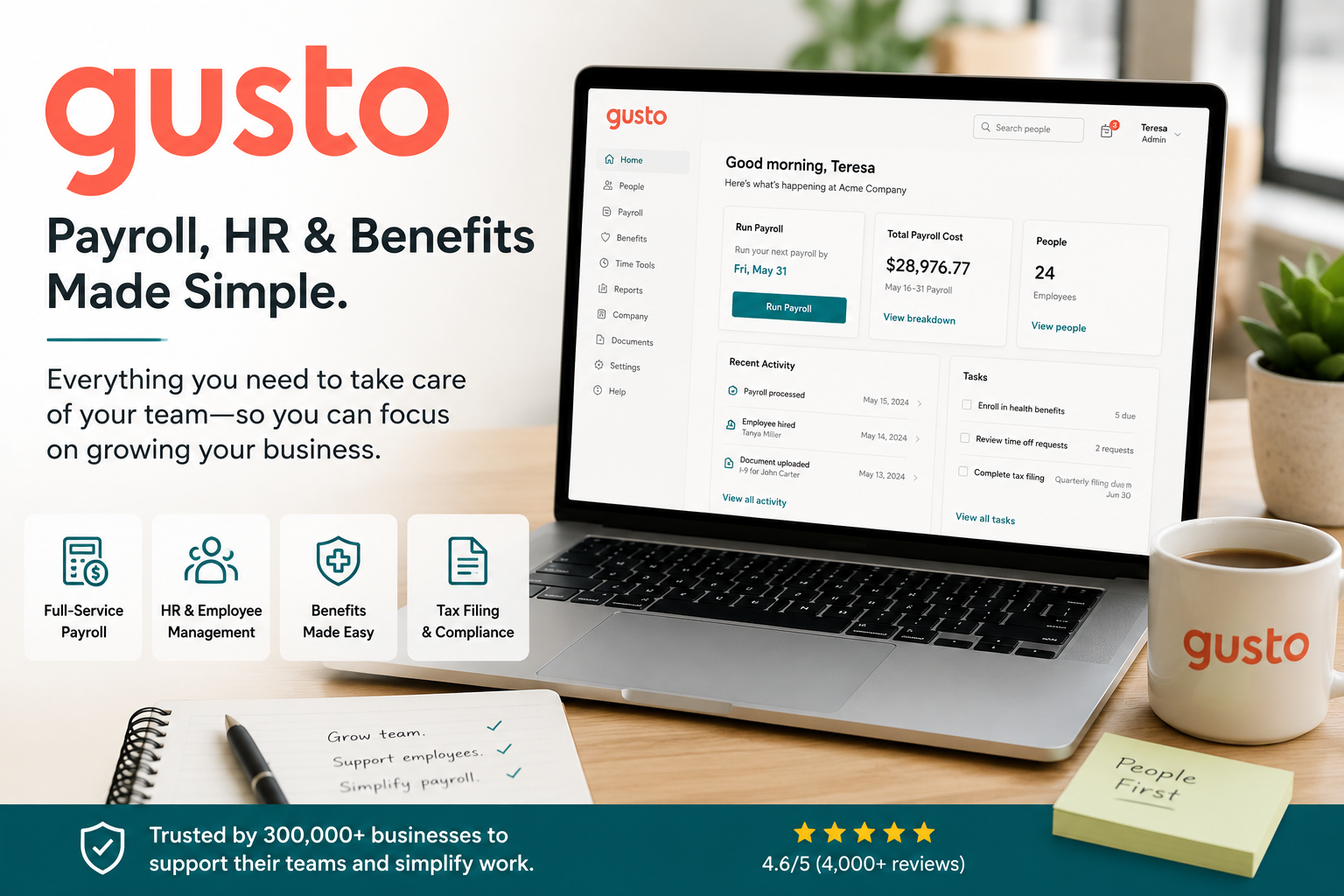
Running a business is exciting until you realize how much time disappears into payroll, employee paperwork, tax filings, benefits, onboarding, time tracking, and HR administration. You start the business because you want to build something profitable, but suddenly you’re spending part of your week figuring out payroll, checking employee hours, answering questions about paystubs, managing PTO, handling new-hire paperwork, and making sure everything is ready before the next payroll deadline. That’s exactly where Gusto becomes appealing. Gusto brings payroll, employee benefits, HR, hiring, onboarding, time tracking, and employee management into one platform, giving small businesses a way to replace scattered spreadsheets, emails, and separate systems with a more organized workflow.
The biggest reason to consider Gusto is simple: payroll shouldn’t consume your time. Nobody starts a business because they enjoy calculating payroll taxes or organizing employee documents. You want to focus on customers, sales, products, employees, growth, and revenue. Unfortunately, payroll still has to be done correctly. Gusto is designed to take much of that repetitive work away from the business owner. The platform supports payroll processing, payroll tax filing, employee payments, digital paystubs, benefits, hiring, onboarding, time tracking, PTO, and other HR functions. Instead of treating payroll as a separate task that you have to remember every few weeks, Gusto turns it into part of an organized business system.
Payroll is where Gusto makes its strongest first impression. The platform can calculate payroll, handle payroll tax filings, issue W-2s and 1099s, manage deductions, support different pay schedules, and provide employees with access to their pay information. Gusto also offers unlimited payroll runs on its plans, which can be useful when you need to make bonuses or additional payments outside your normal schedule. The biggest advantage isn’t simply that the software calculates numbers for you. It’s that the entire payroll process can be managed in one place, reducing the amount of manual work involved in paying employees.
Think about how payroll often works in a small business. You collect hours from employees, check spreadsheets, calculate salaries, review deductions, calculate taxes, prepare payments, and then make sure everything has been submitted correctly. If one piece of information is wrong, you may have to go back and correct it. As your team grows, the process becomes more complicated. Gusto is attractive because it can automate much of that workflow. The goal isn’t to turn you into a payroll specialist. The goal is to make payroll something you can manage without spending an entire day worrying about it.
Payroll taxes are another major reason business owners consider software like Gusto. Payroll isn’t simply about transferring money to employees. There are federal, state, and potentially local tax responsibilities involved. Gusto’s full-service payroll offering is designed to calculate, file, and pay applicable payroll taxes. That can remove a major administrative burden from small businesses. Nobody wants to discover that a payroll tax deadline was missed because they were busy dealing with customers or running the business. Having the system handle much of that process can make payroll feel far less stressful.
Another reason Gusto is appealing is its focus on simplicity. Payroll software can become incredibly complicated, especially when you’re looking at enterprise platforms designed for huge organizations. Small businesses don’t necessarily need that level of complexity. They need something that allows them to enter employee information, review payroll, approve it, and move on. Gusto’s platform is designed around this type of experience. The easier the process is to understand, the less time you have to spend figuring out the software itself.
Gusto becomes even more interesting when you look beyond payroll. Payroll by itself isn’t necessarily enough to make one platform stand out because there are many payroll services available. Gusto combines payroll with HR and employee management, which means your employee information, payroll, benefits, onboarding, time tracking, and other administrative tasks can live in the same ecosystem. That can be extremely valuable because the alternative is often having one application for payroll, another for benefits, another for time tracking, another for employee documents, and several spreadsheets holding everything together.
Employee benefits are another area where Gusto can become useful. Small businesses often want to offer benefits but don’t have a dedicated HR department to manage them. Health insurance, dental coverage, vision benefits, retirement plans, HSAs, FSAs, and other employee benefits can create a significant amount of administration. Gusto offers benefits administration alongside payroll, allowing businesses to manage more of these processes from one platform. This can also make benefits easier for employees to understand and manage because their payroll and benefit information can be connected.
Benefits can also help a small business compete for better employees. Salary isn’t the only thing employees consider when deciding where to work. Health insurance, retirement benefits, paid time off, financial tools, and a professional employee experience can all influence a candidate’s decision. A small company may not be able to compete with a large corporation on salary alone, but offering a professional benefits package can make the overall employment package more attractive. Gusto helps small businesses manage some of these benefits without having to build a full HR department.
Employee self-service is another feature that can save business owners a surprising amount of time. Employees regularly need access to paystubs, tax documents, personal information, benefits information, and other employment details. Without a centralized platform, they often have to ask the business owner or manager. That creates interruptions throughout the week. With Gusto, employees can access many of their own documents and information themselves. Instead of answering the same question repeatedly, you can direct employees to their own Gusto account.
Hiring and onboarding are also easier to organize when they’re connected to payroll. Hiring your first employee can feel exciting, but hiring your tenth or twentieth employee can create a mountain of paperwork. You need offer information, employee details, tax forms, onboarding documents, and other records. Gusto provides tools designed to help businesses manage these processes digitally. A new employee can complete relevant information online instead of exchanging documents through email and printing paperwork. This creates a cleaner experience for both the employer and the employee.
That professionalism matters more than many business owners realize. Imagine hiring someone and telling them to email you their personal information, download a PDF, print it, sign it, scan it, and send it back. Now compare that with sending them a structured digital onboarding process. The second experience feels much more professional. It tells the employee that the company has its processes under control. Even if you’re a small business, you don’t have to operate like a disorganized business.
Time tracking is another area where Gusto can save effort, particularly for companies with hourly employees. Instead of collecting hours manually and then transferring them into payroll, Gusto can connect time tracking and payroll. That reduces repetitive data entry and can help lower the risk of accidentally entering the wrong number of hours. When employees work different schedules, overtime, or different locations, having a structured time-tracking process becomes even more useful.
PTO management can also become surprisingly annoying when handled manually. An employee requests vacation, you check their remaining balance, review the schedule, approve the request, and then remember to update your records. As the company grows, this process becomes harder to manage. Gusto provides tools for PTO policies, requests, approvals, and tracking, giving employees and managers a more organized way to handle time off. That means fewer messages asking how many vacation days someone has remaining and fewer spreadsheets that need constant updating.
Gusto is also useful for businesses that work with contractors. Not every company has a traditional employee-only workforce. Agencies, startups, online businesses, and growing companies often combine full-time employees with independent contractors. Gusto supports contractor payments and 1099 workflows, making it easier to manage different types of workers within one system. For businesses that are constantly switching between employee payroll and contractor payments, having one central platform can be considerably more convenient than maintaining multiple systems.
Remote businesses can also benefit from a centralized payroll and HR platform. Employees may be working from different states, and contractors may be located in different countries. That can create additional administrative complexity. Gusto offers multi-state payroll capabilities on applicable plans and provides contractor payment options for international contractors. If your company is growing beyond one location, having software designed to handle a more distributed workforce can become increasingly valuable.
One of the strongest arguments for Gusto is that it can grow with your business. A company with three employees has very different needs from a company with thirty employees. You may initially need nothing more than basic payroll, but eventually you’ll want time tracking, PTO, benefits, hiring tools, employee management, and more advanced HR functionality. Gusto offers different plans that allow businesses to choose a level of functionality based on their needs. That means you don’t necessarily have to purchase the most advanced package when you’re just starting out.
Gusto’s current pricing structure includes Simple, Plus, and Premium plans, with pricing and features varying by plan. The Simple plan is designed around core payroll needs, while Plus adds more HR and workforce management functionality. Premium is designed for businesses that need more advanced support and HR capabilities. Because pricing can change, it’s important to check the current pricing before purchasing, but the bigger question isn’t simply how much Gusto costs. The better question is how much your current payroll and HR process is costing you in time.
Imagine spending four hours every month dealing with payroll and HR administration. That’s forty-eight hours every year. That’s two full days of your life spent on administrative work. And four hours isn’t an unreasonable amount of time for a small business owner who has to manually handle payroll, employee paperwork, PTO, benefits, and other tasks. Once your company grows, the amount of time can increase dramatically. Gusto turns that calculation around. Instead of asking whether payroll software is an expense, you can ask whether spending hours every month doing payroll manually is the more expensive option.
Gusto is particularly attractive for businesses that don’t have an HR department. Large companies have dedicated payroll specialists, HR managers, benefits administrators, and compliance teams. Small businesses usually don’t. The owner often becomes all of those people. That’s why an all-in-one platform can make such a difference. You’re essentially giving yourself a system that helps handle tasks that would otherwise require multiple applications or significant administrative effort.
For startups, Gusto can be particularly useful because startups often need to grow quickly while keeping their operations organized. You may begin with two or three people and then suddenly have ten or twenty employees. The informal processes that worked at the beginning stop working. Employee information becomes harder to track, payroll becomes more complicated, and benefits become more important. Having a proper HR and payroll platform in place can make that transition much smoother.
Agencies can also benefit from Gusto because agencies frequently combine full-time employees and contractors. They may have different compensation structures, project-based workers, and employees working on multiple accounts. Centralizing payroll and contractor administration can make the business easier to manage and reduce the amount of information scattered across different spreadsheets.
Online businesses face a similar challenge. Digital companies can grow extremely quickly. You might start with a few people working remotely and eventually have a distributed team across multiple states or countries. When that happens, the simple spreadsheet-based approach that worked when the company was tiny becomes increasingly difficult to maintain. Gusto gives businesses a more structured system for handling their growing workforce.
Another reason Gusto remains interesting is that the platform continues to develop. Gusto has introduced additional tools and updates around payroll preparation, contractor payments, financial tools, reporting, and employee management. Features that help identify unusual payroll amounts or irregular time entries can be particularly useful because catching a problem before payroll is submitted is much better than discovering the problem after employees have already been paid.
Of course, Gusto isn’t automatically perfect for every company. If you’re running a very large enterprise with highly specialized payroll requirements, you may need a dedicated enterprise HR platform. Businesses with unusual payroll structures should carefully compare their requirements with Gusto’s capabilities before signing up. And if you only have one contractor and almost no employee administration, a full HR platform may be more than you need. The value depends on how complicated your business has become.
For the typical small or growing business, however, Gusto offers a compelling combination. You get payroll, tax administration, employee self-service, benefits, hiring, onboarding, time tracking, PTO management, contractor support, and HR tools in one ecosystem. That combination is what makes the platform more attractive than simply using a basic payroll calculator.
The real selling point is convenience. Imagine running your business without having to constantly think about payroll deadlines. Imagine employees being able to access their own paystubs without messaging you. Imagine new hires completing onboarding digitally rather than exchanging paperwork through email. Imagine tracking PTO without maintaining another spreadsheet. Imagine connecting employee hours directly to payroll. Imagine managing benefits alongside your employee information instead of jumping between several platforms.
That’s the experience Gusto is trying to create.
And that’s why the platform can be worth paying for.
The best business software doesn’t necessarily generate revenue directly. Sometimes its value comes from giving you back the time you would otherwise lose to administrative work. If Gusto saves you several hours every month, prevents avoidable mistakes, simplifies employee management, and makes your business look more professional, the subscription can become much easier to justify.
For a small business owner, time is one of the most valuable resources you have. Every hour spent manually organizing payroll is an hour you’re not spending on customers, marketing, sales, product development, hiring, or growth. If software can handle the repetitive work while giving you more control over the important parts, that’s a meaningful business advantage.
Ultimately, Gusto is not simply about paying employees. It’s about creating a system around your employees. Payroll connects with employee information. Employee information connects with benefits. Time tracking can connect with payroll. Hiring connects with onboarding. PTO connects with employee management. When these pieces work together, the business becomes easier to operate.
If you’re still managing payroll through spreadsheets, calculating everything manually, collecting employee information through email, and maintaining separate systems for HR tasks, Gusto is worth serious consideration. You may initially look at the monthly subscription and wonder whether it’s necessary, but once you calculate the hours you’re currently spending on payroll and HR administration, the equation starts to look very different.
The real question isn’t, “Why should I pay for Gusto?” The better question is, “How much longer do I want to keep doing all of this manually?”
Eventually, most growing businesses outgrow spreadsheets and informal payroll processes. When that happens, having a centralized system can make the transition much easier. Gusto gives small and growing businesses a way to handle payroll and HR without building an entire administrative department from scratch.
Final verdict: if your goal is to spend less time dealing with payroll and HR and more time actually running and growing your business, Gusto is one of the strongest platforms worth considering in 2026.