

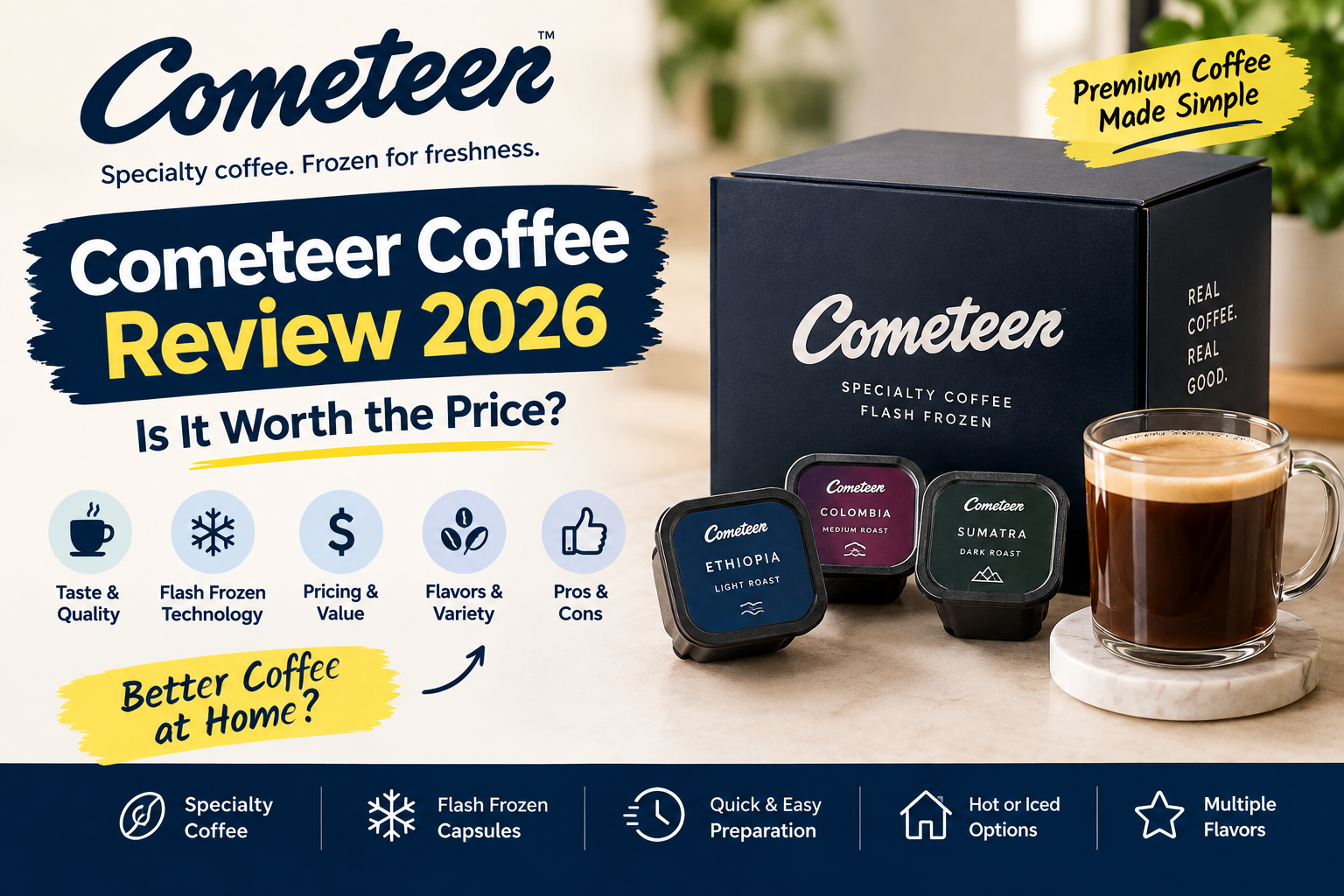
You want a cup that tastes like it came from a good cafe, but you don’t want to grind beans, dial in a brew or scrub a machine before work. That’s the gap Cometeer is trying to fill with frozen coffee capsules you melt and drink.
This Cometeer coffee review 2026 looks at how the system works, what Cometeer costs, how the coffee is described and whether the convenience justifies the price. The short version: it can be a good fit for some coffee drinkers and an expensive detour for others. Let’s get into where the line falls.
[Check Cometeer’s current coffee selection]
What Is Cometeer Coffee?
Cometeer is a coffee company that sells freshly brewed, flash-frozen coffee in small capsules, which the brand also calls pucks. You don’t brew anything at home. You melt a capsule, add water or milk, and drink it.
Cometeer says its coffee is not instant or freeze-dried. Instead, each roast is brewed to 10x strength, then flash-frozen at -321°F, which the company says locks in flavor and aroma. Those are Cometeer’s claims about its own process, and it’s a genuine point of difference from most coffee formats.
It also differs from traditional coffee pods. Those need a brewing machine, while Cometeer capsules need no machine at all. The freezing is meant to preserve the coffee after brewing, rather than leaving freshly ground beans to go stale on your shelf.
How Does Cometeer Coffee Work?
The process has four basic steps:
- Brewing: Cometeer brews each coffee to be highly concentrated (10x strength, per the company).
- Freezing: The concentrate is flash-frozen at -321°F.
- Storage: Capsules ship frozen and go into your freezer.
- Preparing a cup: You melt a capsule, then dilute the concentrate.
Cometeer’s site shows several ways to drink it:
- Hot coffee: Combine a frozen capsule with 6 to 8 oz of hot water.
- Iced coffee: Pour the melted concentrate into 6 to 8 oz of water and ice.
- Latte-style drinks: Pour the melted concentrate into milk or a dairy alternative, then add ice.
- Affogato: Pour melted coffee over vanilla ice cream.
If a capsule melts before you use it, Cometeer says you can refreeze it. Once melted, it keeps its flavor for up to 24 hours at room temperature or 3 days in the refrigerator, according to the company.
Cometeer Coffee Pricing 2026
So, how much does Cometeer cost? The honest answer is that it depends on what you buy. Cometeer coffee prices vary by roast, bundle and whether you subscribe, so treat the figures below as a snapshot of the official site on September 30, 2026.
Subscription and trial pricing. Cometeer’s trial-box page says the trial starts a subscription in 2 weeks for 40 cups at $80 ($2 per cup), shipped every 4 weeks. You can pause, cancel or customize anytime. The site has also advertised a free 16-cup trial offer, so check whether it’s still running.
Bundles. These were listed on Cometeer’s shop page:
| Bundle | Price | Cups | Per Cup |
|---|---|---|---|
| Mixed Roast Explorer | $80 | 40 | $2 |
| Latte Lover | $80 | 40 | $2 |
| Crafted for Iced | $96 | 48 | $2 |
| Decaf Coffee Bundle | $80 | 40 | $2 |
| Half Caff Bundle | $80 | 40 | $2 |
| World Mug Collection | $79 | 32 | $2.46 |
| Single Origin Spotlight | $103 | 40 | $2.57 |
Individual coffees. Most single coffees I saw were listed between about $2 and $3.12 per cup. Rarer coffees, including the Stellar Series lots, ran up to $7.50 per cup.
A few things affect the real cost:
- Volume: Bundles bring the price down to $2 per cup, so a mixed box usually costs less than picking premium coffees one at a time.
- Shipping: The cart mentions free shipping with a minimum order. An older third-party review from late 2024 mentioned a $9.99 shipping fee, so confirm current terms at checkout.
- Taxes and promotions: These can change your final total.
- Old reviews: Prices have shifted over time. That same 2024 review quoted a $64 subscription box, so some older numbers you’ll find online are out of date.
Here’s a quick way to think about it. At $2 per cup, a 40-cup box costs $80. If you drink two cups a day, you’d use about 56 cups in four weeks, which works out to roughly $112 per shipment.
[Check the latest Cometeer pricing]
What Does Cometeer Coffee Taste Like?
Taste is subjective, so here’s what Cometeer says and what independent reviewers report, kept separate from opinion.
Cometeer describes its coffees with tasting notes and flavor labels. Light roasts tend to be labeled things like “sweet and fruity” or “bright and floral,” with notes such as citrus, berry or jasmine. Medium roasts lean “chocolatey and nutty,” and dark roasts are described as bold, chocolatey and full-bodied. Some coffees are single origin, and others are blends.
Strength is partly up to you, since the concentrate is diluted to taste. Cometeer’s suggested 6 to 8 oz of water is a starting point. Acidity and smoothness will depend on the roast, so a light Ethiopian coffee is going to taste different from a dark Brazilian blend.
One independent reviewer at Money at 30 wrote that they enjoyed every cup they tried, but that’s one person’s palate. If you’re picky, start with a mixed box so you can find your preference before committing to a favorite.
Cometeer Coffee Flavors and Variety
Cometeer says it offers 40+ rotating best sellers, seasonal coffees and curated bundles. Coffees come from roasters including Onyx, Klatch, Counter Culture, George Howell, Equator and Intelligentsia, among others.
The lineup includes:
- Roast levels: Light, medium and dark.
- Origins: Single-origin coffees from places like Ethiopia, Colombia, Kenya and Brazil, plus blends.
- Decaf: Several options, including Swiss Water process decafs.
- Half caff: Cometeer says its half-caff roasts have about 90 mg of caffeine.
- Premium lines: Select Series and Stellar Series, described as limited and rare coffees.
- Curated collections: Mixed roast, latte, iced and single-origin bundles, plus a tasting guide with videos from coffee expert James Hoffmann.
The menu rotates, so a coffee you like may not always be in stock. Check the current listings before you plan around a specific roast.
[See Cometeer’s current coffee collections]
Is Cometeer Convenient?
For many people, convenience is the whole point. Here’s how it compares to other ways of making coffee at home.
- Versus beans or ground coffee: No grinder, brewer, filters or grounds to clean up. You skip most of the prep.
- Versus traditional coffee pods: No pod machine needed, though you do need freezer space.
- Versus instant coffee: Cometeer isn’t instant or freeze-dried, so the format is different, though it’s not the cheapest option either.
Prep time is short since you melt the capsule and add water. Cleanup is minimal. Storage is the tradeoff, because capsules live in your freezer. Cometeer also says its capsules are TSA approved, which could help for travel.
Cometeer Pros and Cons
| Pros | Cons |
|---|---|
| Very quick to prepare, with minimal cleanup | Cost per cup is higher than many home-brew methods |
| Specialty roasters and 40+ coffees | Needs freezer space |
| No machine or brewing skill required | Menu rotates, so favorites may not always be available |
| Works hot, iced or with milk | Not ideal for people who like the brewing ritual |
| Decaf and half-caff options | Shipping and availability vary by location |
| Pause, cancel or customize a subscription | Value depends on how often you drink it |
Who Should Buy Cometeer?
Cometeer may suit:
- Busy professionals who want a good cup fast.
- Specialty coffee lovers curious about roasters they can’t easily buy locally.
- Iced coffee drinkers who want a quick, consistent cup.
- People who dislike complicated brewing or don’t want to buy equipment.
- Variety seekers who like trying different roasts and origins.
Who Might Want to Skip Cometeer?
You might do better with another method if you:
- Care most about the lowest cost per cup.
- Enjoy grinding and brewing coffee yourself.
- Don’t have freezer space to spare.
- Prefer freshly ground beans.
- Drink large amounts of coffee every day, since the cost adds up.
Cometeer vs Traditional Coffee
| Feature | Cometeer | Traditional Coffee |
|---|---|---|
| Preparation | Quick: melt and dilute | More prep, depending on method |
| Convenience | High | Depends on brewing method |
| Storage | Freezer | Pantry or airtight container |
| Variety | 40+ rotating coffees | Extremely broad |
| Equipment | Minimal | May need a grinder and brewer |
| Cost | About $2 per cup on bundles, more for premium lots | Varies widely |
Neither is universally better. Traditional coffee gives you more control and, often, a lower cost. Cometeer trades some of that for speed and simplicity.
Is Cometeer Worth the Price?
It depends on what you’re paying for. Here’s how the main factors stack up.
- Convenience: Strong. Melting a capsule beats brewing.
- Coffee quality: Cometeer emphasizes specialty roasters and careful brewing, though taste is personal.
- Variety: A wide, rotating menu.
- Prep time: Very low.
- Cost per serving: Around $2 on bundles, which is more than many people spend brewing at home.
- Your preferences: If you like the process of making coffee, you may not value what Cometeer removes.
Cometeer may be worth considering if convenience and specialty coffee quality matter more to you than the lowest possible cost per cup. If you’re mostly chasing savings, it probably isn’t the best choice.
[Explore Cometeer’s latest coffee options]
Cometeer Alternatives
If Cometeer doesn’t feel right, these are the main alternatives:
- Freshly ground coffee: More control and usually a lower cost per cup, but it needs equipment and time.
- Traditional coffee pods: Simple and machine-based, with a wide range of brands and prices.
- Specialty coffee subscriptions: Fresh-roasted beans delivered regularly, which still need brewing.
- Instant specialty coffee: Quick and shelf-stable, though the taste and format differ from Cometeer.
I haven’t named competing brands or prices here, so compare current pricing on each before deciding.
Final Verdict
Cometeer is a subscription-friendly frozen coffee system that lets you make a brewed-style cup without a machine. Capsules are brewed to 10x strength, flash-frozen and melted at home. Bundles currently work out to about $2 per cup, with premium coffees costing more.
The main advantages are speed, variety and easy iced coffee. The main drawbacks are cost, freezer space and a rotating menu. It’s best suited to busy people and specialty coffee fans who value convenience.
So is Cometeer worth considering? Yes, if you fit that profile. Check current pricing first, and start small to see whether the taste and routine work for you.
[Check Cometeer’s current coffee selection]
FAQ
What is Cometeer coffee?
Cometeer sells brewed coffee that’s concentrated and flash-frozen into small capsules. You melt a capsule and add hot or cold water, or milk. The company says it isn’t instant or freeze-dried, and that the process preserves flavor. Cometeer offers a rotating menu of coffees from specialty roasters.
How much does Cometeer coffee cost?
On the official site, bundles were listed at about $2 per cup, such as $80 for 40 cups. Some coffees run higher, up to about $7.50 per cup for premium lots. Prices, promotions and shipping can change, so check the current listing before buying.
Is Cometeer coffee worth the price?
It can be if you value convenience and specialty coffee over the lowest cost. At roughly $2 per cup on bundles, it costs more than many home-brewing methods. Whether it’s worth it depends on how often you drink coffee and what you’d otherwise spend.
Does Cometeer coffee need to be frozen?
Capsules ship frozen and are meant to be stored in your freezer. If a capsule melts, Cometeer says you can refreeze it if it isn’t used immediately. Melted coffee keeps its flavor for up to 24 hours at room temperature or 3 days in the fridge.
How do you prepare Cometeer coffee?
Melt a capsule, then dilute it. For hot coffee, combine a frozen capsule with 6 to 8 oz of hot water. For iced coffee, pour the melted concentrate over 6 to 8 oz of water and ice. You can also add it to milk for a latte-style drink.
Is Cometeer better than regular coffee?
Neither is universally better. Cometeer is faster and needs no equipment, while regular coffee offers more variety, control and often a lower cost. Which one is better depends on whether you prioritize convenience or price and brewing flexibility.
How long does Cometeer coffee last?
Cometeer says frozen capsules preserve peak flavor for months, though exact timing depends on the product and storage. Check the packaging for dates. Once melted, the company says flavor holds for up to 24 hours at room temperature or 3 days in the refrigerator.